


There is no mystery to tokenized shares of stock. Since issuing the share itself as a token does not work under present law, we have to resort to an instrument that represents the shares. The idea of issuing an instrument that represents economic rights or beneficial interest in shares of stock, so that investors can hold and trade the economics of the shares without owning the underlying shares, has been perfected decades ago in the form of depositary receipts (e.g., American Depositary Receipts, Global Depositary Receipts, and Philippine Depositary Receipts).
In this note, we discuss how a depositary receipt (DR) is typically structured, then we apply this model in structuring a tokenized equity security.
The principal motive behind DR programs of corporate issuers was to raise funds in another jurisdiction while avoiding cross-listing (the DRs are issued offshore, while the shares stay onshore). Without doubt, this is also the principal motive behind tokenized shares.
Part 1. Structuring a depositary receipt.
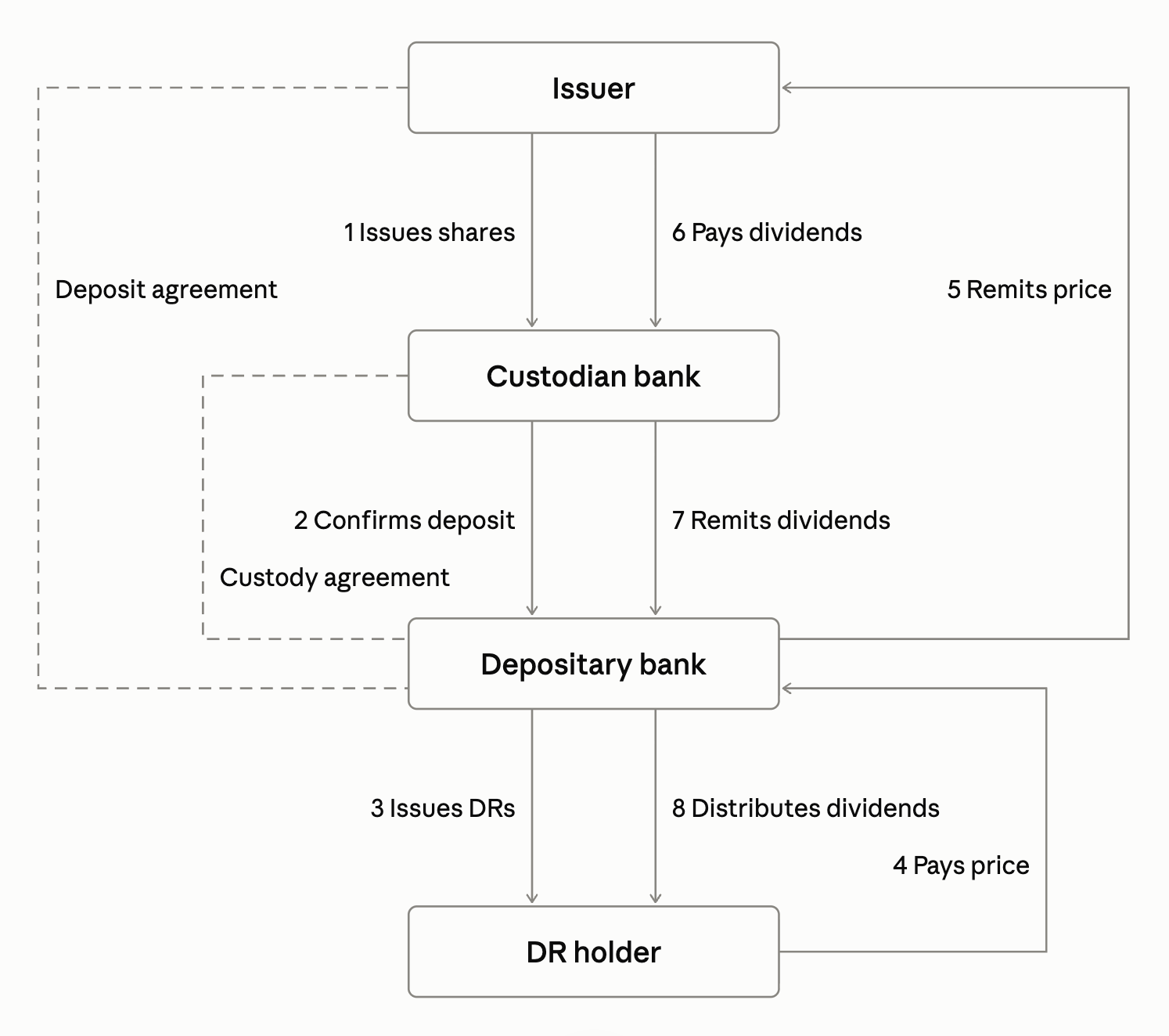
A depositary receipt is an instrument issued by a depositary that evidences a beneficial interest in shares of an issuer held on deposit by a custodian. The holder never takes title to the shares. It holds the receipt while the receipt gives it the economic and, through the depositary, the voting rights attached to the underlying shares.
The deposit agreement is between the issuer and the depositary. It authorizes the depositary to issue receipts against the issuer’s shares, fixes the ratio of receipts to shares, and sets out how the depositary will pass through dividends, distributions, notices and voting rights to holders. In an unsponsored program, there is no such agreement and the depositary acts on its own initiative. In a sponsored program, which is the norm for listed receipts, the issuer is a party and bears part of the cost.
The custody agreement is between the depositary and the custodian. The custodian is a bank in the issuer’s home jurisdiction which holds the deposited shares in its name for the account of the depositary. The depositary is the registered shareholder of record through the custodian. The receipt holders are the beneficial owners.
Transaction steps
1. The issuer issues shares to the custodian. In a new-issue program, these are primary shares. In a program built on existing stock, a selling shareholder delivers already-issued shares to the custodian instead.
2. The custodian confirms to the depositary that the shares have been received and are held for the depositary’s account.
3. On that confirmation, the depositary issues receipts to the holder in the agreed ratio. The receipts are registered in the depositary’s books or delivered through a clearing system.
4. The holder pays the price of the receipts to the depositary.
5. The depositary remits the price to the issuer, net of its fees, in the currency of the deposit agreement.
6. The issuer pays dividends and other distributions on the deposited shares to the custodian as the shareholder of record.
7. The custodian remits the amounts to the depositary.
8. The depositary converts the amounts into the currency of the receipts, deducts its fees and any withholding tax, and distributes the balance to holders pro rata. Notices, rights offerings and voting instructions run along the same route. The issuer sends them down to the depositary, the depositary sends them to holders, and holders’ voting instructions travel back up for the custodian to cast the votes on the deposited shares.
Part 2. Structuring a tokenized equity security.
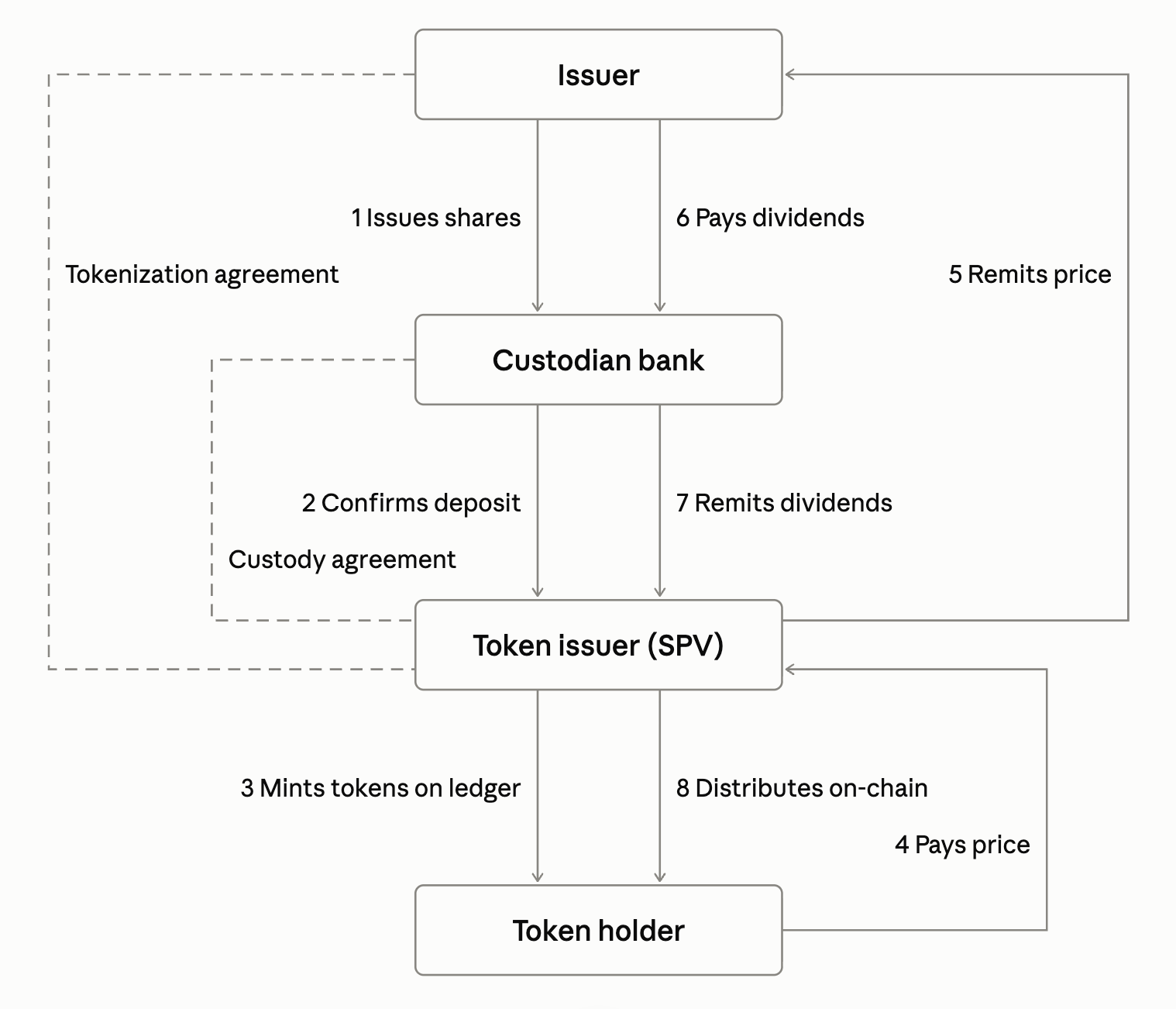
A tokenized equity security is a digital token recorded on a distributed ledger that represents economic rights or beneficial interest in the shares of an issuer.
The tokenization agreement is between the corporate shares issuer and the token issuer. It authorizes the token issuer to mint tokens against the issuer’s shares, fixes the ratio of tokens to shares, and sets out how dividends, notices and voting rights will be passed through to token holders. It also specifies the ledger, the token standard and the smart contract that will govern the tokens, and whether the issuer has any control over transfer restrictions coded into the contract. The token issuer is ordinarily a special purpose vehicle rather than a bank, formed for the single purpose of holding the shares and issuing the tokens, so that its balance sheet contains nothing else and the tokens are insulated from the credit risk of the sponsor.
The custody agreement is between the token issuer and the custodian. The custodian is a bank or licensed securities custodian in the issuer’s home jurisdiction which holds the deposited shares in its name for the account of the token issuer. The token issuer is the shareholder of record through the custodian. The token holders are the beneficial owners.
Transaction steps
1. The issuer issues shares to the custodian, or a selling shareholder delivers existing shares to the custodian.
2. The custodian confirms to the token issuer that the shares have been received and are held for the token issuer’s account.
3. On that confirmation, the token issuer mints tokens on the ledger in the agreed ratio. Minting is a function call on the smart contract. The contract records the tokens against the holder’s wallet address, and the address becomes the entry in the register. The contract typically restricts transfers to addresses that have been whitelisted after identity and eligibility checks, so that the token cannot move to a person the issuer would not have been able to sell to directly.
4. The holder pays the price of the tokens to the token issuer, in fiat or in a stablecoin, depending on what the tokenization agreement and the settlement rails permit.
5. The token issuer remits the price to the issuer, net of its fees.
6. The issuer pays dividends and other distributions on the deposited shares to the custodian as the shareholder of record.
7. The custodian remits the amounts to the token issuer.
8. The token issuer distributes the amounts to token holders pro rata, either by conventional transfer to the bank account linked to each whitelisted address or on-chain in a stablecoin, with the smart contract computing each holder’s share from the ledger balance at the record time. Notices are delivered to the holder’s registered contact and, where the contract supports it, recorded on-chain. Voting instructions travel back up the chain. Holders vote through the platform, the token issuer aggregates the instructions, and the custodian casts the votes on the deposited shares.
For a Philippine issuer, the token is a security under the Securities Regulation Code, and its offer and sale require registration or an available exemption in the same way as the underlying shares. The platform on which it is minted and traded, and the entity holding the tokens or private keys for customers, are subject to the relevant licensing regime of the SEC and the BSP for digital asset securities and virtual asset services.
Geronimo Law advises on virtual asset service provider (VASP), crypto-asset service provider (CASP), securities regulation, crypto-assets and fintech.