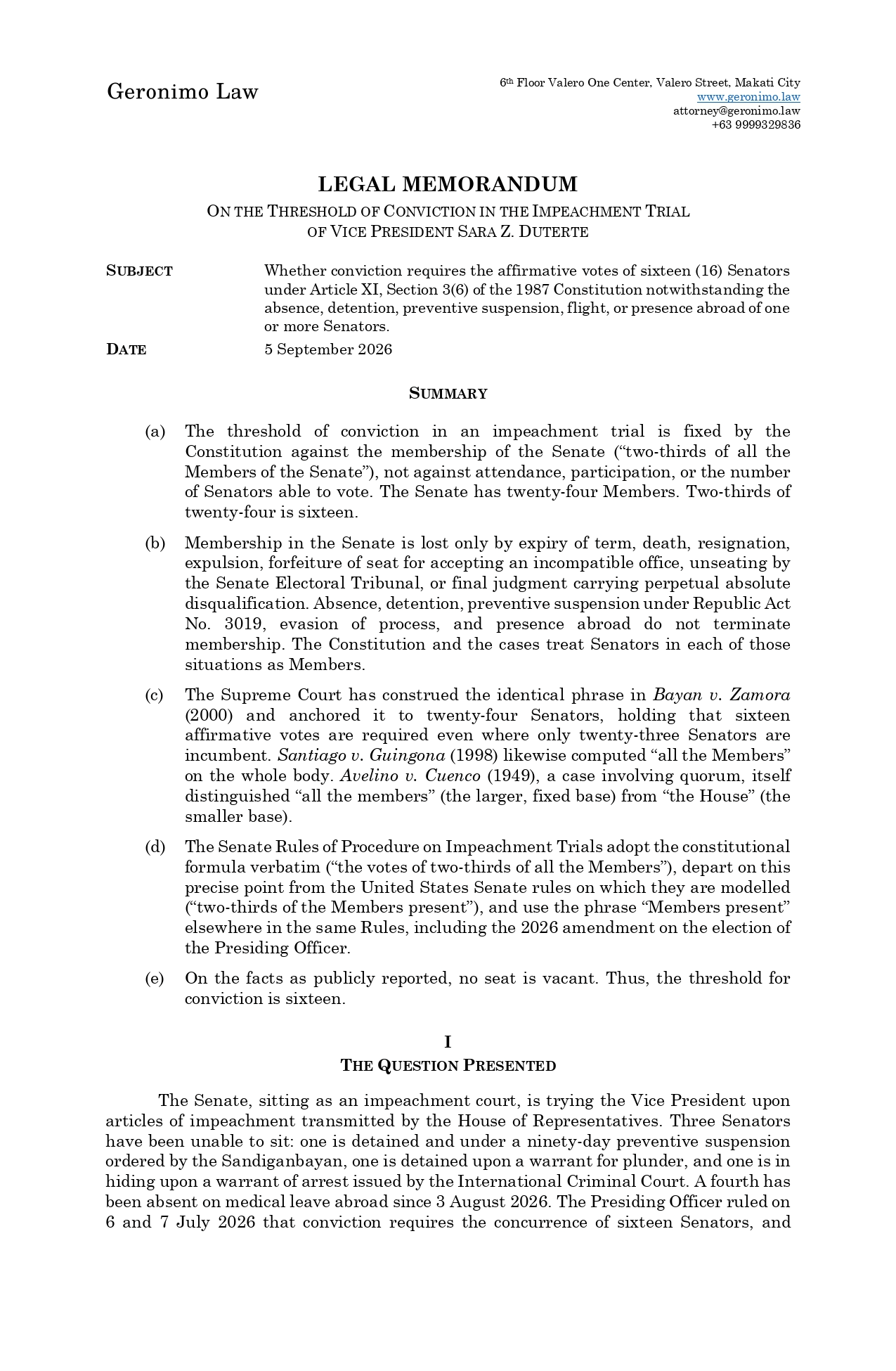
An analysis of Article XI, Section 3(6) of the Constitution and why “two-thirds of all the Members of the Senate” fixes the conviction threshold at sixteen votes.
A review of Supreme Court decisions interpreting the phrase “all the Members,” including Bayan v. Zamora, Santiago v. Guingona, and Avelino v. Cuenco.
An explanation of why absence, detention, preventive suspension, evasion of process, or presence abroad does not terminate Senate membership or reduce the constitutional voting base.
An examination of the Senate’s impeachment rules and why their use of “all the Members,” rather than “Members present,” supports the sixteen-vote threshold.
Constitutional Law and Impeachment Advisory
Geronimo Law provides legal analysis on constitutional interpretation, impeachment, legislative procedure, public office, and disputes involving the powers and composition of government institutions.
This section addresses common concerns raised by businesses, legal teams, and finance professionals looking for clarity on complex issues and get a better understanding of key concepts.
How many Senate votes are required to convict Vice President Sara Duterte in an impeachment trial?
The memorandum concludes that conviction requires at least sixteen affirmative votes, because Article XI, Section 3(6) requires the concurrence of two-thirds of all Members of a Senate constitutionally composed of twenty-four Senators.
Can the conviction threshold be lowered if some Senators are absent, detained, suspended, or abroad?
No. The memorandum states that absence, detention, preventive suspension, evasion of process, or presence abroad does not terminate Senate membership and therefore does not reduce the number of votes required for conviction.
Why does the memorandum conclude that the impeachment threshold is based on all Senate Members, not only those present?
The memorandum explains that Rule XXI of the Senate’s impeachment rules uses the constitutional formula “two-thirds of all the Members.” It notes that the corresponding U.S. Senate rule uses “Members present,” while the Philippine Senate substituted “all the Members.” The same Philippine rules also use “members present” elsewhere when that is the intended standard.


.webp)


