

Geronimo Law, through this author, has worked with The Asia Foundation on a blue carbon policy study and on carbon credit project advisories with various clients. This article seeks to provide a foundational overview of the framework for Philippine carbon credits issuance and trading, and transfer of Internationally Transferred Mitigation Outcomes (ITMOs) under the Paris Agreement.
The Paris Agreement is a 2015 treaty under the UN Framework Convention on Climate Change (UNFCCC). Each country that joins it files a pledge, called a nationally determined contribution (NDC), stating how much it will cut its greenhouse gas emissions by a given year, and reports its progress to the UNFCCC. The Philippines has pledged a 75 per cent reduction against its projected 2030 emissions, most of it conditional on outside finance and technology.
A carbon credit is a unit that stands for one tonne of carbon dioxide equivalent kept out of the atmosphere, whether by cutting emissions or by sequestering carbon. Credits are issued by private registries after an independent verifier confirms the tonnes, and they are bought and sold, mostly by companies that want to offset their own emissions.
In the voluntary market, credits are issued on registries such as Verra and Gold Standard and traded on exchanges.
The Paris Agreement, in Article 6.2, lets one country meet part of its NDC with reductions achieved in another country. A reduction transferred this way is an Internationally Transferred Mitigation Outcome, or ITMO. An ITMO transfer is the sale of such a reduction from a project in the host country to a buyer country.
The best way to understand an ITMO transfer under the Paris Agreement is to first have a working knowledge of the voluntary carbon market sans the ITMO aspect. After that, one can begin to understand how the Paris Agreement adds the elements of state consent and state carbon accounting.
In this article, we set out in Part 1 how a carbon credit is structured from the property owner to the buyer in the voluntary market, then in Part 2 we add Article 6.2 elements.
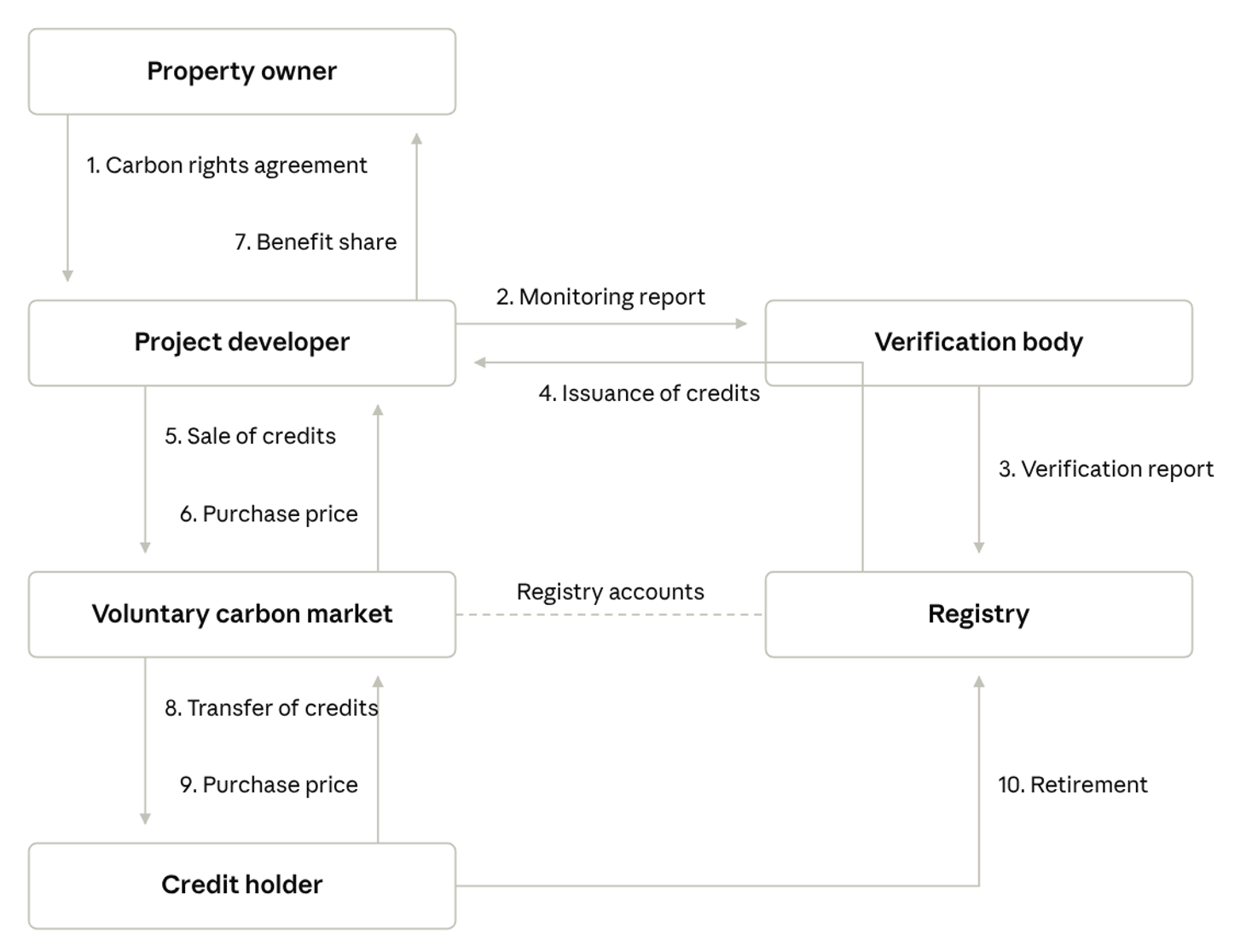
Here, the carbon rights agreement is between the property owner and the project developer. It conveys to the developer the right to claim, register and sell the emission reductions or removals arising from the land, together with the right to be listed as project proponent before the registry. Various contract titles include: deed of assignment of carbon rights, a land lease or usufruct with a carbon clause, a benefit sharing agreement, a project development agreement, or an emission reduction purchase agreement (ERPA), as may be applicable.
An ERPA is a forward sale of verified units and fits only where the landholder is itself the proponent and the developer is buying output. Where the developer is to become the account holder and proponent, the instrument has to assign the carbon right itself, since the landholder has nothing to deliver before issuance.
In the Philippines, the "owner" is often the State, and the counterparty is a tenure holder under a Community-Based Forest Management Agreement (CBFMA), a Protected Area Community-Based Resource Management Agreement (PACBRMA), or a similar instrument. Tenure holders may include LGUs and people's organizations.
The verification body is a third party accredited by the standard. It validates the project design against the methodology and later verifies each monitoring report. The registry is operated by the standard (Verra, Gold Standard and their equivalents). It opens accounts, issues units against verified reports, records transfers and records retirement.
The voluntary carbon market is not a single venue. It is the set of brokers, exchanges and bilateral buyers through which credits move from the developer's account to a holder's account. The holder is the end buyer, usually a corporate that retires the credit against its own emissions.
Transaction steps
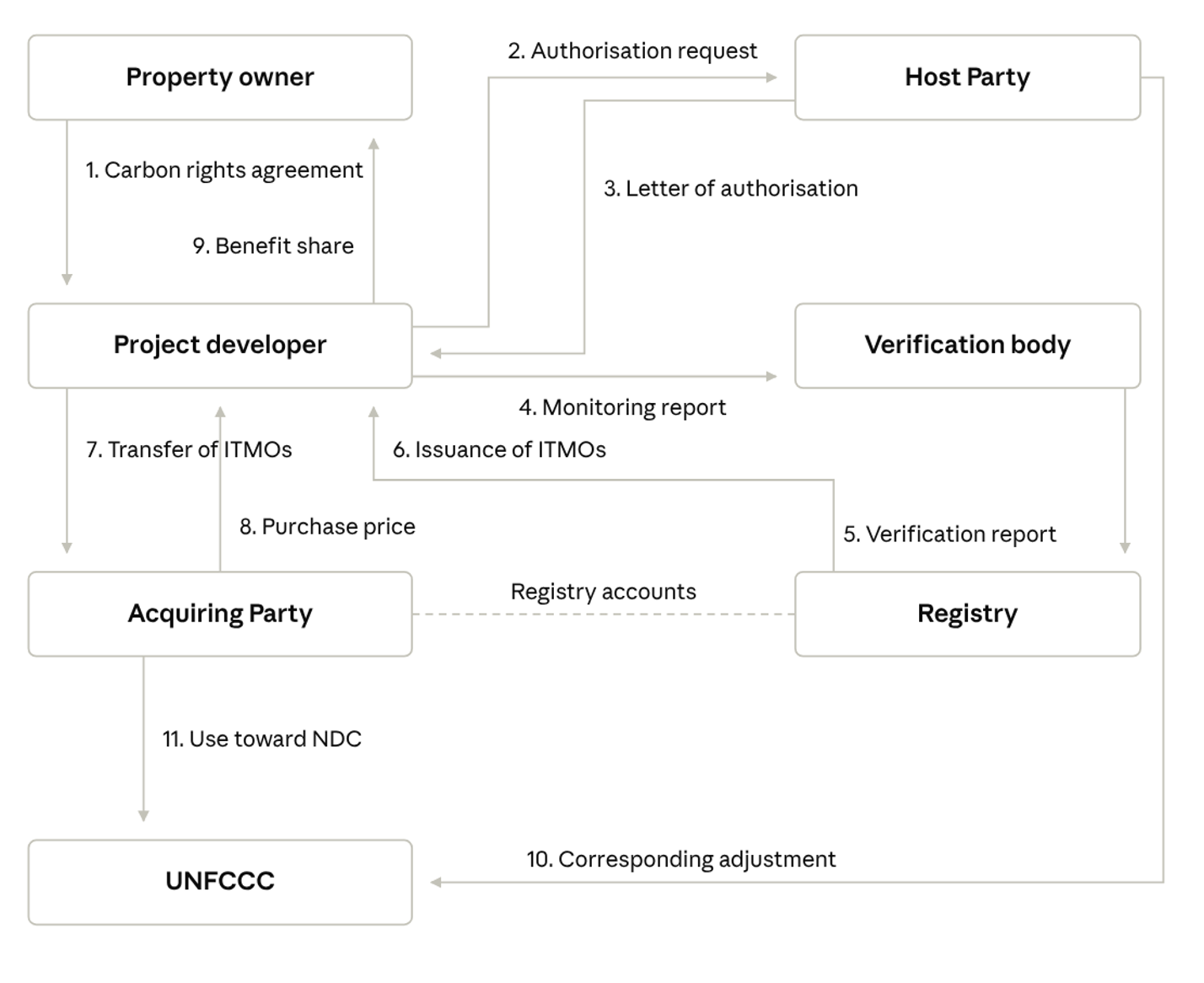
An ITMO is a mitigation outcome, measured in tonnes of carbon dioxide equivalent, that the host Party has authorized for international transfer and for use toward another Party's NDC or for other international mitigation purposes, and against which the host Party applies a corresponding adjustment.
The cooperative approach agreement is between the host Party and the acquiring Party. It is a bilateral treaty or implementing arrangement under Article 6.2 that fixes which activity types are eligible, which methodologies and standards are accepted, how authorization is granted and whether it can be revoked, what share of proceeds goes to adaptation, what proportion of units is cancelled for overall mitigation, and which registry records the transfers. Japan's Joint Crediting Mechanism and the Swiss bilateral agreements are the working models. The Philippines signed its first such agreement with Singapore on 30 April 2026. However, the authorization process under it has not yet been activated.
The letter of authorization is issued by the host Party to the project developer. It names the activity, the crediting period, the purpose of use (NDC of the acquiring Party, CORSIA, or other), and the registry. From the moment of first transfer, the host is bound to adjust its own accounts.
The carbon rights agreement, the verification body and the registry are the same as in Part 1, with two changes. The carbon rights agreement has to give the developer the right to apply for authorization in the owner's name or its own, and has to allocate the risk that authorization is refused, delayed or later revoked. The registry has to be one that the cooperative approach agreement recognizes and that can tag a unit as authorized and record the corresponding adjustment reference, whether that is the host's national registry, the acquiring Party's registry, or an international registry.
The acquiring Party is the buyer country, acting directly or through an entity it has authorized, such as a carbon tax-liable company or an airline under CORSIA. The UNFCCC does not hold units. It receives the reports.
Transaction steps
The corresponding adjustment at steps 10 and 11 is an accounting entry by the state in its reporting to the UNFCCC. This is why ITMOs cannot be structured without the state, and why a voluntary credit with no letter of authorization is not an ITMO.
Where the mangroves or forest are State-owned, which under the Constitution covers nearly all of them, the property owner in Figures A and B is the State acting as owner through the DENR. In that case, the carbon rights agreement cannot be signed by the State directly with a developer in the ordinary way. A tenure instrument has to exist between the State (as grantor of the tenure) and a tenure holder, such as a local government unit or a people's organization. These instruments may be in the form of a CBFMA, a PACBRMA, an Industrial Forest Management Agreement, a Forest Land Use Agreement, a co-management agreement with the LGU, or, for ancestral domain, the Certificate of Ancestral Domain Title with the FPIC memorandum of agreement.
The tenure holder then signs the carbon rights agreement with the developer, and that carbon rights agreement is only as good as the tenure instrument behind it. The tenure instrument must therefore allow or permit the carbon rights agreement, either by its own terms or by an addendum or clearance from the DENR, because most of these instruments bar assignment or sublease without DENR approval.
Geronimo Law advises on carbon credit project structuring, legal documentation, and policy.