


The Philippines passed the boldest foreign investment reforms in a generation, but foreign capital still went elsewhere.
On paper, no country in South-East Asia has done more to court foreign capital than the Philippines. In a span of four years, Congress amended the Public Service Act to admit full foreign ownership of telecoms, airlines, railways and shipping; rewrote the Foreign Investments Act to ease entry for small enterprises; lowered the paid-up capital thresholds of the Retail Trade Liberalization Act; cut corporate tax and rationalized incentives under CREATE, then sweetened them again under CREATE MORE; and lengthened foreign land leases to 99 years.
The 13th Foreign Investment Negative List, issued in April 2026, then consolidated these gains and confirmed the removal of renewable energy, once treated as a nationalized natural resource, from the restricted roster.
A protectionist constitution, largely untouched since 1987, was relaxed by legislation to a degree that would have been unthinkable ten years ago.
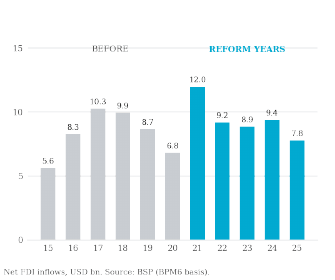
The market’s verdict has been harsh. Net foreign direct investment, which peaked at $12 billion in 2021, fell to $7.8 billion in 2025, the weakest showing in five years and, setting aside the pandemic, the weakest since 2015. The current year has been worse: net inflows for January to May 2026 collapsed by a third to $2.2 billion, and May’s $210 million was the lowest monthly reading since March 2015, before any of the reforms existed.
Over the same period ASEAN as a whole pulled in record inflows exceeding $225 billion a year, with Vietnam and Indonesia feasting on the supply chains fleeing China. Less foreign capital is entering the country today than before the rules were opened.
The first error was to mistake legal reform for investor confidence. The reforms removed ownership caps, but ownership caps matter only when the rest of the business environment works. A foreign company may now own 100% of a Philippine railway, but it must still buy some of the most expensive electricity in Asia, move goods through congested ports at logistics costs far above regional norms, and hire from a labor market whose best engineers are already in Singapore or Riyadh. Liberalization removed the legal barriers but left the cost of doing business untouched. Vietnam, with a less liberal statute book, offers cheaper power, better logistics and a credible pipeline of trade agreements. Investors went where operating costs are lower, not where ownership rules are friendlier.
The second error was partiality. The constitution’s 60-40 rule still governs land, natural resources, media, education and anything a court may yet deem a “public utility”. The Public Service Act amendment survives, for now, under a constitutional cloud, and every sophisticated investor prices the possibility that the Supreme Court unwinds it, as it has unwound contracts before. A 99-year lease sounds generous, but the lessee still cannot own the land under a billion-dollar plant and is exposed to pre-termination and counterparty risks.
The third error was execution. The implementing rules of CREATE MORE came out late, and investors put their decisions on hold while waiting. The Fiscal Incentives Review Board and the investment promotion agencies spent years fighting over jurisdiction, while PEZA locators fought the tax bureau over VAT refunds and work-from-home rules. An incentive that must be litigated is no incentive at all.
Then there is governance. The flood-control scandal of 2025 did more damage to the investment case than any ownership cap.
It confirmed the suspicion that public money in the Philippines leaks, that budgets are auctioned, and that the state cannot reliably deliver the infrastructure on which private returns depend.
Governments offer incentives
when they cannot offer credibility.
The anticorruption drive that followed was necessary and, in the short run, ruinous: public construction stalled, growth slid to 4.4% in 2025 and to 2.6% in the first half of 2026, with the second quarter’s 2.3% the softest reading, pandemic aside, since 2009.
Fixed investment contracted by 13.7% in that quarter, the sharpest fall in over five years, while Vietnam grew 8.4% and Indonesia 5.3%.
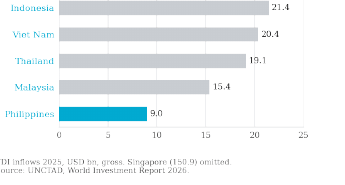
Capital gathers where capital is already located, i.e., near suppliers, skilled workers and businesses that have already succeeded. Vietnam’s electronics cluster and Indonesia’s nickel value chain compound annually.
A latecomer cannot simply match its rivals’ terms; it must offer more to catch up. The Philippine reforms, for all their drama, only leveled the rules. The country remains behind on costs, certainty and industry clusters.
The Philippines stopped at the easy half of liberalization. The hard half is constitutional revision of the economic provisions. It includes judicial reform so that courts resolve commercial disputes in months rather than decades. It entails lowering the cost of doing business rather than introducing more incentives, and ratification of the trade and investment treaties that give foreign capital external enforcement when domestic institutions wobble. Governments offer incentives when they cannot offer credibility. The Philippines has spent four years perfecting its incentives, and the central bank’s dismal monthly figures show what that earned. It should now invest in credibility, which costs more and takes longer, but is what investors have been looking for all along.




.webp)


